Dorm rooms
21 Dorm Room Storage Ideas—No Drilling Required
A practical dorm-room storage plan using vertical, hidden, and daily-use zones without drilling holes or filling the floor with organisers.
By Vivek · July 29, 2026
Save to Pinterest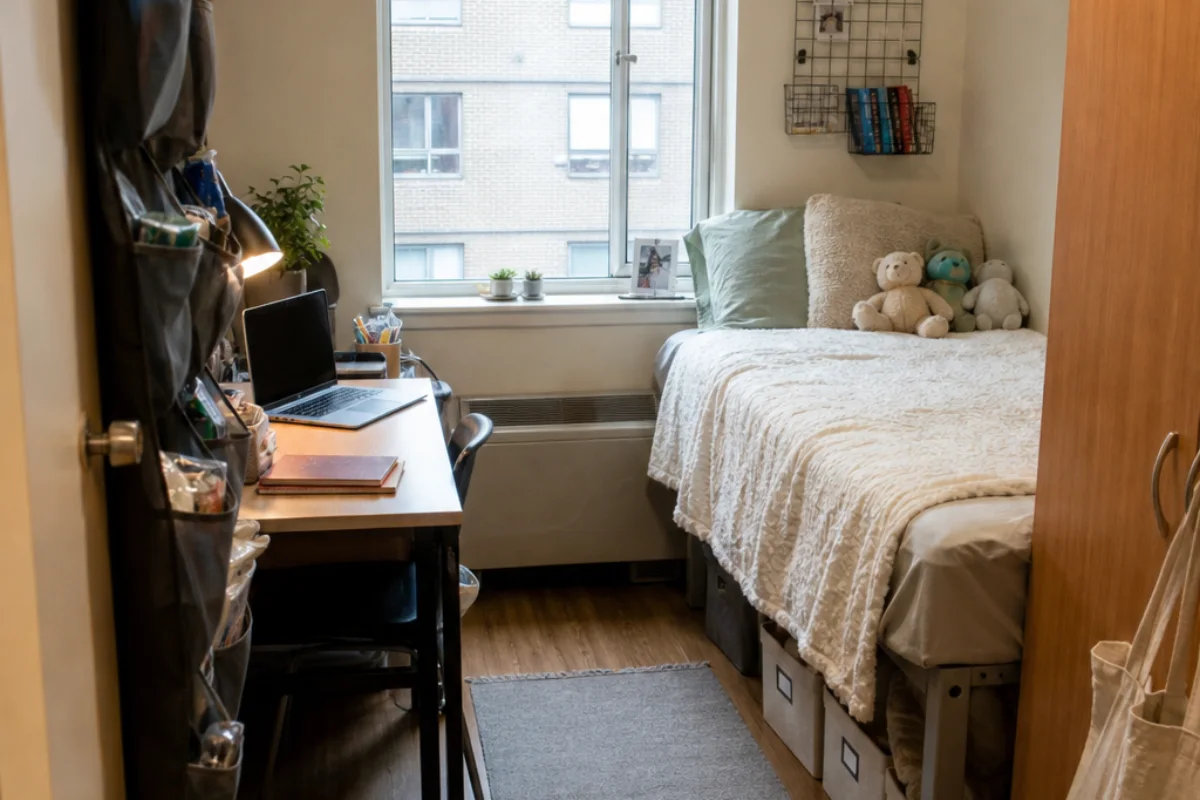
Dorm rooms are not short on storage products.
They are short on space.
That sounds obvious, but it changes what you should buy. A basket that only holds things is not automatically useful. It still needs somewhere to live. In a tiny room, every organiser has to justify the floor, wall, or door space it takes.
Here is the rule I would use:
Store upward, hide the bulky things, and keep only daily items within reach.
Everything below follows that rule.
Start with three storage zones
Before buying anything, divide the room into three zones.
| Zone | What belongs there | Good locations |
|---|---|---|
| Daily-use | Keys, chargers, toiletries, current books | Desk edge, bedside caddy, one hook |
| Hidden | Spare bedding, luggage, seasonal clothes | Under the bed, inside cases, storage ottoman |
| Vertical | Shoes, cleaning supplies, bags, folded clothes | Doors, wardrobe rail, tall narrow shelving |
If something does not have a zone, it will end up on the chair.
And then the chair becomes storage.
You know how that goes.
1. Raise the bed before adding another cabinet
Bed risers can turn unusable space into the biggest storage area in the room. Measure the existing clearance, the riser height, and the height of any boxes before buying.
Do not guess from a product photo. A box that is two centimetres too tall is just a box you now have nowhere to put.
2. Use shallow boxes for things you need often
Deep boxes look efficient until the item you want is at the bottom.
Use shallow, labelled containers for T-shirts, gym clothes, cables, food, or stationery. Reserve deep boxes for spare bedding and things you will not touch every day.
3. Keep luggage working
An empty suitcase is wasted storage.
Fill it with off-season clothes, spare towels, or the bags you only use for travelling. Keep a short note on your phone listing what is inside. Otherwise you will forget and buy the same thing again.
4. Add an over-door organiser
This is one of the few organisers that creates storage without taking floor space.
Use it for shoes, cleaning products, snacks, bathroom supplies, or rolled clothing. Check that the hooks do not stop the door from closing and that the organiser does not cover a fire-safety notice or ventilation grille.
5. Use the inside of the wardrobe door
If the hinges and clearance allow it, the inside of the wardrobe door can hold a light fabric organiser, mirror, or a few removable hooks.
Keep the load light. A thin wardrobe door is not a structural wall.
6. Double the hanging rail
A hanging rail extender creates a second level for shirts, trousers, or short jackets.
It works best when most of your clothes are short. If you own long coats and dresses, leave one section full-height instead of forcing everything into two cramped rows.
7. Put shelf dividers in the wardrobe
Tall piles collapse because nothing stops them moving sideways.
Clip-on dividers create lanes for knitwear, towels, bags, and bedding. They are boring. They also work.
8. Hang bags from one removable hook rail
Scattering individual hooks across the room makes the wall look busy.
One removable rail near the door is easier to use and easier to remove. Follow the surface instructions, respect the stated load, and test one strip before trusting the paint.
9. Add a bedside caddy
A fabric caddy that slips under the mattress can replace a bedside table.
Keep it for your phone, glasses, headphones, and one book. Do not turn it into another drawer full of cables.
10. Use a storage ottoman only if it does two jobs
An ottoman makes sense when it stores bulky items and gives you useful seating.
If it blocks the walkway or becomes a dumping ground, it is just a large upholstered box.
11. Put a rolling cart beside the desk
A narrow cart can hold stationery, food, toiletries, or a printer. The point of the wheels is not decoration. It means you can move the cart when cleaning or when you need more desk space.
Measure the gap first.
12. Add a clamp-on desk shelf
A clamp-on shelf can create a second level without drilling into the wall. It is useful for light items such as notebooks, headphones, and small stationery trays.
Check the desk thickness and clamp depth. Do not clamp heavy equipment to weak particleboard.
13. Mount a light pegboard with the approved system
Some dorms allow removable mounting systems; some allow nothing on the wall.
Ask before installing it. If it is allowed, use it for light supplies rather than heavy books or appliances.
14. Use one cable box
Loose extension leads make a small room look untidy quickly.
Use one ventilated cable box or tray, keep power bricks uncovered enough to release heat, and never hide damaged cables because the room looks better that way.
15. Create a charging tray
Put your phone, watch, earbuds, and battery pack in one shallow tray.
It removes four objects from the desk and gives you one obvious place to check before leaving.
16. Use shelf risers
A shelf riser creates a second layer inside a wardrobe or cupboard without making the lower items inaccessible.
Use the bottom for daily items and the top for lighter, less-used items.
17. Store shoes vertically
A narrow shoe tower or over-door organiser uses height instead of depth.
Keep only the shoes you actually wear at college. The rest do not need premium dorm-room space.
18. Put laundry in a tall, narrow hamper
Wide baskets consume floor area. A tall hamper fits more easily beside a wardrobe or behind a door.
A removable liner also makes the trip to the laundry room less annoying.
19. Give food one defined area
Food spreads across a room when it has no boundary.
Use one cart shelf, crate, or cupboard section. Keep it away from heat, check residence rules for appliances, and throw away packaging you no longer need.
20. Use vacuum bags for the right things
Vacuum bags work for spare bedding and out-of-season clothes.
They are terrible for something you need every Tuesday. Use them for long-term compression, not daily access.
21. Keep one empty container
This sounds inefficient.
It is not.
The empty container catches the things that have not found a proper home yet. Empty it once a week. Without that buffer, those objects end up across the desk, floor, and bed.
What to measure before buying anything
- Floor-to-bed clearance.
- Wardrobe width, depth, and rail height.
- Door thickness and the gap above it.
- The clear walkway between the bed and desk.
- Desk thickness for clamps.
- The dimensions of the lift, stairwell, and car you will use on move-in day.
One last thing.
Do not buy all 21 ideas.
Choose the three places where clutter already collects. Fix those first. A dorm room feels organised when daily life is easier, not when every surface has a matching container.
Continue with the room-by-room small apartment storage plan or the small closet organisation guide.