Bathroom storage
Small Bathroom Storage Ideas—No Drilling Required
Organise a small rental bathroom using the door, vanity, vertical gaps, and a strict daily-use zone without relying on permanent shelving.
By Vivek · July 29, 2026
Save to Pinterest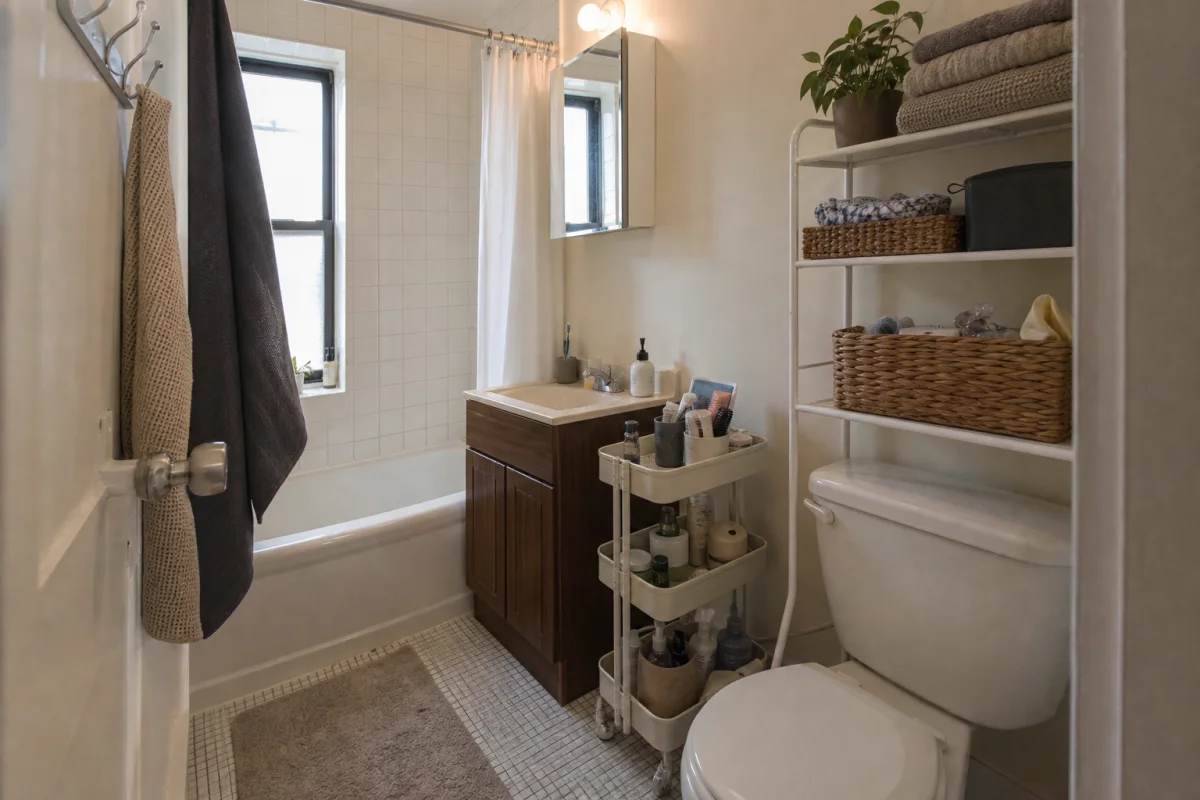
Small bathrooms do not become messy because people are lazy.
They become messy because ten daily products are trying to live on a sink designed for two.
The fix is not to hide everything.
It is to separate daily use, backups, cleaning, and laundry so those categories stop occupying the same surface.
Keep one daily-use tray
Put the products used every morning and night on one washable tray.
Everything else leaves the sink.
The tray creates a boundary, catches drips, and makes cleaning faster. If the products no longer fit, decide whether all of them are actually daily.
Use the vanity in layers
The cupboard under the sink is awkward because pipes divide the space.
Use shallow drawers, stackable bins, or adjustable shelves positioned around the plumbing. Keep access to valves and joints clear.
Do not build a perfect storage wall in front of the thing a plumber may need urgently.
Put backups together
Spare soap, toilet rolls, shampoo, and unopened products belong in one labelled zone.
When the zone is full, stop buying backups. A small bathroom cannot become a warehouse because something was discounted.
Use an over-door organiser
The back of the door can hold towels, cleaning cloths, hair tools when cool, or spare toiletries.
Check the door thickness, hinge clearance, and organiser depth. Make sure it does not hit a wall, radiator, or shower screen.
Consider a narrow rolling trolley
A trolley works when there is a real gap and when it can move for cleaning.
Measure the floor at skirting-board height. A trolley that fits above the skirting may still fail at the wheels.
Use the top for daily items, the middle for towels, and the bottom for heavier cleaning products kept safely.
Use a tension caddy carefully
A tension-pole shower caddy can add vertical storage without drilling.
It needs suitable opposing surfaces and proper installation. Check stability regularly. Do not overload it with large bottles and do not use it where a fall could injure someone or damage glass.
Put shower products in one caddy
Whether it hangs, stands, or sits in a corner, use one system.
Three different baskets make the shower harder to clean and give half-empty bottles somewhere to hide.
Store towels by actual demand
Keep the towels currently in rotation in the bathroom.
Store the large reserve elsewhere if the room cannot support it. Towels absorb moisture, and an overcrowded humid cupboard is not automatically good storage.
Use the space above the toilet without creating risk
A freestanding over-toilet unit can work if it is stable, appropriately secured where required, and does not interfere with the cistern, controls, ventilation, or safe use.
Keep light items above head height. Do not balance glass jars and heavy bottles where they can fall.
Add removable hooks only after testing the surface
Hooks are useful for robes, hand towels, and light tools.
Bathrooms are humid. Adhesive and paint behave differently in moisture and temperature changes. Use a product suited to the surface and environment, follow its instructions, and test removal risk.
Give hair tools a cooling zone
Hot tools need a heat-safe place to cool before storage.
Do not put a hot straightener into a plastic organiser, closed drawer, or fabric pocket. Keep cables loose enough to avoid strain and unplug appliances according to their instructions.
Keep cleaning products contained
Store bathroom cleaning products together, upright, and away from children or pets.
Never mix chemicals. Keep labels readable. Storage advice does not override the safety instructions on the product.
Put laundry somewhere deliberate
A narrow hamper, hanging laundry bag, or divided basket outside the bathroom may work better than a wide basket inside it.
The correct location is the one that does not block the door or stay damp.
Decant only when it makes sense
Matching bottles look tidy. They can also remove instructions, ingredients, expiry information, and safety labels.
Do not decant products simply for appearance when the original packaging contains information you need.
Clear the floor
Every bottle on the floor adds an obstacle to cleaning.
Use the caddy, trolley, or cupboard. Leave the floor to the bathmat and necessary fixtures.
That one change makes a tiny bathroom feel calmer immediately.
A fifteen-minute reset
- Remove empty packaging.
- Put daily products on one tray.
- Group backups in one bin.
- Group cleaning products safely.
- Move spare towels out if they do not fit.
- Clear the floor.
Then wait before buying anything.
The missing organiser becomes obvious only after the categories are visible. Buy that one item, measured for that one location.
Not six matching baskets because the bathroom looked nice online.
Continue with the small-apartment storage plan.